Friday, December 15, 2006

Seeing and Believing and Acting


Exercise Your InkTank

Last night's craftshop exercise was one of those had-to-be-there things. (There was some acting involved, a foam bear claw, a dead plant, and a box of kleenex.) But for those of you (and you know who you are) who might be curious about what you missed, you'll find the gist of it below.


Because our talk about formatting and submitting manuscripts is (let’s face it) never very exciting, I thought we’d do something with a little zip in it tonight. Experiments in perspective—and by that I mean the writer’s way of seeing, not the character’s or speaker's—are always interesting because they remind us of ourselves as unique seers. As artists we have a responsibility to see—and record—the news of the world. Sometimes we forget this because we’re worried about POV shifts and space breaks and all of those criminally irritating mechanical concerns. It’s time to be reminded.

I’ll need a few randy volunteers for this experiment—let’s say three—who are willing to sacrifice a little on-the-spot writing time. We’ll concoct a moment, which we’ll then present to the group. The group’s task will be to record the scene as though witnessing it in the “real” world and to imagine the world around the scene. Write a poem, a story, follow the event where you like. We’ll share our work and see a little more clearly (perhaps) how we see. Use the space below to record as many details as you can as the action is taking place or directly thereafter. We’ll share these notes too.

InkTank Writers’ Salon Guidelines


Workshop Guidelines
Manuscripts must be submitted at least one week in advance of the assigned workshop slot. Otherwise, we’re all in trouble. Use our yahoo group and/or distribute copies by hand. Submit work that has been edited to the best of your abilities. Unedited work embarrasses everybody. We’re adopting (almost) professional formatting standards because it makes sense to learn them and work with them. We understand that e-mailing your work may disrupt your formatting—do the best that you can.

Titles: Pick one. Don’t italicize it, underline it, enlarge it, or type it in a wacky font. (It’s tempting, we know, but resist.)

For Prose: Submit no more than 25 double-spaced pages. Use 1-inch-or-so margins and a 12pt-or-so inoffensive font. (Most folks agree that Times and Courier are the standard.) Include your name and the date in a header and page numbers in the upper right corner. Your unadorned title should be centered above your first paragraph of text.

For Poetry: Submit no more than 10 pages. If the size or look of the font are somehow involved in your meaning making, they may vary to your little heart’s desire. Otherwise, keep it simple. Include your name and the date in a header and page numbers in the upper right corner. Your unadorned title should appear directly above your first lines of text.

For Everything Else: Use common sense.

Response Guidelines
Comment directly on the manuscripts up for workshop. Be nice, but don’t be so nice as to render your comments useless. Don’t ever be mean. Be critical, yet sensitive to the writer. If talking isn’t your style, make sure you offer more written commentary. If writing on the manuscript isn’t your style, make sure you give good verbal commentary. We’ll roll around the room and give everyone a chance to talk. Don’t use this as an opportunity to soapbox—keep it brief. It isn’t a bad idea to start with a positive. If you haven’t read the work, don’t comment—we won’t be offended if you leave at the break, but we will be offended if you huff off mid-workshop, or snooze.

Craftshop Guidelines
Craftshop topics are generated by group members. Speak up if you have an idea. The exercises give us a basis for a little technical or philosophical discussion and a chance to do some writing on the spot. If you’d like to share your craftshop results during the Salon, speak up. A little conversation about your work may transpire—nothing too serious. If you’d like to share your craftshop results later, send them to the yahoo group and they’ll be published on the blog. Anyone (even those who miss the meetings) is welcome to submit craftshop exercises for publication. Exercise sheets will appear on the blog after the Salon meets.

Salon Ethics
It’s simple: You’ve got to give at least as much as you receive. If everyone abides by this simple notion, the life of the Salon will be a dream. But if you don’t offer good commentary, don’t expect it in return. If you can’t abide by our guidelines, don’t expect us to be happy about it. Expect us to be sad. Expect us to think things about you. Remember that the Salon is free—it costs you nothing to be a member—but that does not mean it’s yours for the taking. It belongs to all of us and none of us; it is what it is. Please don’t try to make it something else and please don’t abuse it.

Wednesday, December 13, 2006

Salon Writers Write "Bad"


Untitled by Jason Gallagher

George. His name was George. With a name like George how could he have such a throbbing piece of man meat? It was juicy, huge in its girth but with the right amount of length. Not too much, just enough. It would fit comfortably inside my tight box. Try not to think about your own pussy while it is taking in that glorious member. I remember the pinch as it entered but I didn’t turn my head, I didn’t grimace. It was differently not something to cry over. I knew it would be over soon. There was no reason to not let him go through the motions. The thrusting would be deep; there was no better word for it then penetration. Teeth grinding with the intensity of each pound. Yet gentle. Each movement was forceful and gentle. That is how the whole thing can be deceiving. You think that it will be more then it is.


MOANS IN THE NEIGHBORS' SHED by Kalman Kivkovich

I hear the groans coming from the neighbors' shed.
The heavy breathing sounds like something out of my dreams.
I'm fifteen and dreams I have---flood of wet dreams . . .
I glue my eye to a crack in the wooden wall.
My gaze pierces the soft skin that blocks my view.
The moans fill the enclosed space beyond.
What the hell is it? My mind gears in full speed.
I close my eyes.
Something is bulging inside my trousers,
Thrusting against the already dilapidated partition.


WET DREAM by Kalman Kivkovich

I submit to a deep sleep,
Or do I?
Millions of thoughts, fragments of unidentified reflections,
Rushing through my resting head,
Thumping inside my skull,
Like giant waves on shore, beating against the boulders.
My mind struggles to focus into the hazy twister,
To grasp the indistinguishable.
And there she is,
Slowly advancing, floating toward me,
Like a mirror image out of the Greek mythology.
A spark in my brain turns my body over---once, twice.
I feel warm throughout,
My tongue searches for moisture off my lips,
I utter from within.
The lids of my closed-eyes tighten evermore.
My breath turns heavy,
My blood pulsates in an unrestrained rhythm.
My body stretches and again turns over.
I am being transferred away.
Where am I?
Now I feel my bare feet, resting on smooth pebbles,
I am standing on a still, dry riverbed.
I hear something,
A faint but rising sound.
It's coming closer,
Now it is roaring,
Oh God . . . the water!
I am going to drown,
I am on top---I am under.
I am wet,
My eyes open.


SEX WRITING WORKSHOP by Marie O'nan

We always had to kick the dog out of our bedroom before being intimate.
We always had to call it being intimate because Sylvia didn't want to say
fuck and she didn't want to sound like an easy listening song. All she
could say was weiner. "Oh Richard," she'd say, "I love your weiner." Or,
"Oh, your beautiful weiner."
"Sylvia," I'd say, "It's your weiner too. We share it like how siamese
twins share whatever it is that connects them."
Last night, we started to get intimate. The windows were open a little
because it was warm outside. You could smell the rain. Virgil howled
outside our door. He must've heard thunder. "Richard," she said, "Give me
your weiner."
"Sylvia," I said, "Fuck me hard." I don't know why I said it. I was
scared she would slap me, but she didn't. She just kept going the same as
before. I heard the rain and the dog crying and Sylvia's breathing and I
felt lucky.

Friday, December 01, 2006

Dirty Bird


Exercise Your Inktank
Bad Sex

I will confess I was dreading the prospect of writing bad literary sex scenes as examples for discussion. Thankfully, the Literary Review’s 2006 Bad Sex Award winner was announced yesterday. The judges say the award’s mandate is “to draw attention to the crude, tasteless, often perfunctory use of redundant passages of sexual description in the modern novel, and to discourage it.” Here are their criteria for bad sexiness: “unconvincing, perfunctory, embarrassing or redundant sex scene in an otherwise sound literary novel.” Pretty vague, if you ask me, but otherwise maybe fairly sound. If you already know the winner, hold your tongue. Otherwise, read through these selections and see if you can pick it. A disclaimer: the following excerpts contain seriously graphic sexual content that may not be appropriate for some readers and may completely ruin our chances of ever having a grown-up conversation about the topic.

David Mitchell from Black Swan Green
“Now she made a noise like a tortured Moomintroll.”
Irvine Walsh from Bedroom Secrets of the Master Chefs:
“Skinner took his thick green slime and spread it like a chef might glaze some pastry…A ludicrously distended clitoris popped out from nowhere like a jack-in-the-box.”

Thomas Pynchon from Against the Day
“Ruperta had trained her toy spaniel to provide intimate ‘French’ caresses of the tongue for the pleasure of its mistress. …Reef followed, taking out his penis, breathing heavily through his mouth. 'Here Mouffie, nice big dog bone for you right here.’”

Julia Glass from The Whole World Over:
“And then before her inner eye, a tide of words leaped high and free, a chaotic joy like frothing rapids: truncate, adjudicate, fornicate, frivolous, rivulet, violet, oriole, orifice, conifer, aquifer, allegiance, alacrity…all the words this time not a crowding but a heavenly chain, an ostrich fan, a vision as much as an orgasm, a release of something deep in the core of her altered brain, words she thought she'd lost for good.”

Mark Haddon from A Spot of Bother:
“And it swept over her like surf sweeping over sand then falling back and sweeping up over the sand again and falling back. Images went off in her head like little fireworks. The smell of coconut. Brass firedogs.”

Will Self from The Book of Dave
“The confusion of their bodies—his hairy shanks, her sweaty thighs, his bow-taut cock, her engorged basketry of cowl and lip.”

Tim Willocks from The Religion
“He bent her across the cold steel face of the anvil...she called out to God and convulsed with each slow stroke, her head thrown back and her eyelids aflutter, and her cries filled the forge…until she squeezed him from inside and he exploded to a prayer of his own within her body.”

Iain Hollingshead from Twentysomething
“And then I’m inside her, and everything is pure white as we're lost in a commotion of grunts and squeaks, flashing unconnected images and explosions of a million little particles…I can feel her breasts against her chest. I cup my hands round her face and start to kiss her properly. She slides one of her slender legs in between mine. ‘Oh Jack,’ she was moaning now, her curves pushed up against me, her crotch taut against my bulging trousers, her hands gripping fistfuls of my hair. She reaches for my belt. I groan too, in expectation. And then I'm inside her, and everything is pure white as we’re lost in a commotion of grunts and squeaks, flashing unconnected images and explosions of a million little particles.”

The Challenge:
Write some bad literary sex. Attempting the worst can be as instructive as attempting the best. Use any of the above passages as a model, or create your own scenario.

Monday, November 20, 2006

Writing Violence


Exercise Your InkTank
Extreme Violence

The conversation about violence in storytelling is often one about the writer’s intent. If the writer’s intent is to shock the audience with extreme violence for the purpose of mere entertainment, we tend to categorize the violence differently than we might other kinds of violence in writing—we call it gratuitous. But violence that is sneakily used for the purpose of teaching readers a lesson might also be accurately called gratuitous. In both cases, readers have cause to resist and cause to dismiss; in both cases the reader’s sensitivity to violence is subject to the writer’s designs.

That said, I do think there is a place in literature for crazy gonzo blood splat gratuitous violence, as well as preachy politico tearjerk baby bye-bye violence. But what I’m more interested in talking about tonight is storytelling. The fact is that violence happens in the world. And the fact that it isn’t pretty or pleasant shouldn’t keep us from writing about it, though it may make the task more challenging.

If you slow down the pacing of the story around the violence, embellishing it with lots of details, the word gratuitous may stick to you—you may even be accused of glorifying violence. But if you speed it up and race right past it, you may be justly deemed a scardey cat. If the violence in your stories always happens off screen, it may be that you are mistaking your own fear, for the desires and needs of the story.

Here’s some advice from Chris Offutt, a writer who knows a good deal about it. I’ve summarized things he has said on the subject in workshop and out: write violence if you must, because you must, but write about it with the same care you’d take with anything. Your prose should be energized, not hyper. If you decide to take a clinical distance, don’t make it so cold you disappear. Be there.

A writer who does this well, I think, is Denis Johnson. This is an excerpt from “Car Crash While Hitchhiking” from the short story collection Jesus’s Son:
And later, as I’ve said, I slept in the back seat while the Oldsmobile—the family from Marshalltown—splashed along through the rain. And yet I dreamt that I was looking right through my eyelids, and my pulse marked off the seconds of time. The Interstate through western Missouri was, in that era, nothing more than a two-way road, most of it. When a semi truck came toward us and passed going the other way, we were lost in a blinding spray and a warfare of noises such as you get being towed through an automatic car wash. The wipers stood up and lay down across the windshield without much effect. I was exhausted, and after an hour I slept more deeply. I’d known all along exactly what was going to happen. But the man and his wife woke me up later, denying it viciously.
“Oh-no!”
“NO!” In a minute the driver, who’d been slumped over the wheel, sat up and peered at us. His face was smashed and dark with blood. It made my teeth hurt to look at him—but when he spoke, it didn’t sound as if any of his teeth were broken.
“What happened?”
“We had a wreck,” he said.

A literary writer who is known for his extreme violence is Cormac McCarthy. No conversation about violence in the literary world would be complete without him. Here’s an excerpt from the novel Blood Meridian:
And now the horses of the dead came pounding out of the smoke and the killing ground and clattered from sight again. Dust stanched the wet and naked heads of the scalped who with the fringe of hair below their wounds and tonsured to the bone now lay like maimed and naked monks in the bloodslaked dust and everywhere the dying groaned and gibbered and horses lay screaming.

And now a little challenge:

In order that there be some correspondences between our work tonight, I’ll ask that we all write about the same scenario and that’s the scenario presented in the excerpt from “Car Crash.” In other words, let’s write about a car crash. Why didn’t I just say that? Write against the impulse to glorify violence and against the impulse to hide from it.

Salon Writers Write


The following submissions are the happy results of our various craftshop exercises. We thank our Salon members for sharing their work with us and welcome others to do the same. Submit work for publication on the Salon blog by sending it violettuce@juno.com or via the Salon's yahoo group.

VIOLENCE, WORKSHOP
By Sujata Naik

There she was. weaving, for the past twenty minutes, ahead of me. Then gone. Tumbling down the left curb. I found myself speeding up to the spot. Then scrambling down. Where the steering wheel had met the driver, blood and some innards splattered man and machine. His neck seemed to have cracked. The head lay limp, hanging lose to one side. A toy. No groans, no moans. No moans, no groans. Looking back, it makes me sick. Then, then I only took what was given.
My thought was more to immediate myself than the driver. It could have been me. Thank God he's dead, I don't have to make the effort to extricate the mess. I remember being angry with the dead man. Angry that he had been weaving. Angry, like some religious fanatic, that he had been drinking. No, I had no time to feel sick. Or grieve for the stupid. Then, only then, did I call 911


THE CITY
by Sujata Naik

The city
is alive and kicking well , thank you.
Just discharged,
minor stitches.
Thankful that
its innards are not derelict,
desolate
crime-sneaking
(unlike Buffalo).
Here, it's
the very propah
who sneak in,
on the Washingtonparkers.
A glass of beer
camouflaged in a
coffee mug.
Everything
has a chamillion quality.
Even corruption.
Not cops shaking
you down for a fiver
But schools and providers
Kids is education
Kids is big bucks
Tomorrow sneaks in on the city
Tomorrow, robbed
even of its shadow.


FOUND POEM
by Sujata Naik

This world...

Mythical walk
down
The syntax street.
This world,
an instruction
in
my own devices.
Fractured, found
fractured.

(suddenly industrious Sujata
Suddenly
industrious
I)


HELL ON I-71
by Kalman Kivkovich

"Papa," I said, "I'll miss you." My throat was burning. Will I see you again? I thought. This thought had hit me many times lately. He was not doing so well since mother's departure---something to do with his heart.
"You'll see me again," he said with a soft smile, as if he read my mind. "Israel is just a flight away . . ."
"Sure," I said. I kissed his cheek just before he boarded the plane to New York. Would it be for the last time? The thought kept gnawing my mind as I was driving back to Cincinnati.
It was early afternoon, a pleasant spring day. I was sad to see Dad leave, but I was happy that at least he managed to visit me in Cincinnati. My parents always had promised to do that. At least he did.
My eyes darted from the road ahead to the empty seat beside me. He was just there . . .

I-71. North bound. Traffic is light. I am trailing on the slow lane. I guess thinking has something to do with my pressing on the gas peddle. The seat beside me is still empty.

BOOOM*** I was startled to my core. "What the . . ." BOOOM*** The explosive sounds came from my left side. A FORTY-FIVE footer obstructed my view. My hands were on the steering wheel, but my Monte Carlo was flying on an autopilot controlled by the fucking truck driver. My white vehicle was dancing on the highway. Don't ask me how, but after several zig zags, and I mean ZIG ZAGS, I found my car positioned perpendicular to the freeway. My hands at that point were off the steering wheel. I was helpless and hopeless for the ride. The front passenger seat was still empty, except all the glittering glass fragments that littered the maroon velvet upholstery. There was no window left intact. The GIANT was still obstructing my left view. This time it was the front of the MONSTER. I could have reached and grabbed the grill. The fucker-trucker was pressing on, pushing me forward . . . I grabbed the shiny chrome grill . . . "STOP!!!!"
For a freaking short second it seemed as if my adversary driver or God had listened to my plea. Somehow a gap of a few feet opened between us. I am still alive . . . maybe---
BOOOM*** The gap was gone. He was coming for the kill. I closed my eyes . . . I must have been praying. I could hear the screeching of the tires below; they were turning fast but taking me nowhere. Burned-rubber smell seared my nostrils. Is it over? Is it Heaven . . . it feels more like Hell . . .
BOOOM*** No, it wasn't over. My deformed car and I were airborne. My eyes were still closed, but I could feel the flight. It must be my last---
TAHHH*** It was a short ride that ended with a thunderous blast of metal-concrete collision. We hit the median. One tire exploded. We bounced off back to the center lane.
SILENCE. Am I alive? I got out of the wreckage. It wasn't a car. I don't remember opening any door or climbing though a window opening. All I remember was staggering away from a smoking thing and dropping to the asphalt.
"Are you okay? The ambulance is on its way. I'm a nurse . . ."
"What?"
"Don't move . . . you'll be fine," she said, gently wiping the blood off my face. "What's your name?"
"What?"
"Your name?"
"Papa . . . Papa, are you okay? Papa . . ."
"You were alone in your car," she said. "Your Papa must be okay. Relax. Oh, I can here the sirens."
"What happened?" I asked, trying to focus on her face.
"You were hit by a semi. You were so lucky."
"Where is he?"
"There," she said, pointing. The Devil was parking about one hundred yards ahead.
Traffic was lined up for who knows how far. The paramedics had arrived, trailed by the police and fire trucks.
I was on my way to Bethesda North. They wanted to clean me up and make sure that there was no trace of concussion. By that time I felt more alive, far more than I had felt a little while ago. I quivered at the thought that my father could have been sitting in that seat beside me. Oh God, thank you . . .

"I'm sorry, but I have to write you a ticket," the officer said, standing by my hospital bed.
"What?"
"There were witnesses."
"What witnesses? He just hit me . . ."
"I'm sorry," he said, handing me the orange paper. "You can fight it in court if you wish. Sign here please."
"Okay . . ."
"By the way, were you wearing a seatbelt?"
"I . . ."
"Never mind . . . you must have been."

"I-71 has reopened after Thursday afternoon crashes near Hyde Park.
A police dispatcher with the Ohio State Highway Patrol told 9News that two separate collisions involving semi-trailers occurred almost simultaneously on both North and South bound. Emergency crews took two people to the hospital. No names or conditions have been released. 9News, Hagit Limor reporting."
"More news after this . . ."


VIOLENCE
by Dick Mashburn

Basic facts: Loaded cement truck approaching intersection at bottom of steep hill. The traffic light for traffic coming down the hill is red. The truck driver apparently disregards the signal and crashes into the mid-section of the auto, killing driver and passenger in the car.

Our job is to figure out why truck ran red light.

The accident investigator later said that the truck could have stopped. Testing showed that the brakes were fully functional. That left intent as the only plausible reason for the wreck, but there was no motive, unless the truck driver had a reason or no reason at all, if worthiness of motive counts, for running the red light and vaporizing the sedan that was filled with a young man and young woman just a moment ago and is now filled with bloody body parts.

Wasn't the truck driver Rodney Smerling?, thought Officer Albertson

Didn't he graduate from high school in the same class as Bart and Molly, who only seconds ago were probably on their way to a class picnic? If I weren't working, I'd be on the way myself.

But I have no clue as to any motive involving the three of them.

Rodney and Bart and I played on the same high school football team, did't we? wondered Officer Albertson. Was there ever tension between him and me?

And what about Molly? Could Bart have intended to put her in the path of the truck? What if she was pregnant? What if she was carrying Rodney's child?

Friday, November 17, 2006

At Long Last


Electric Queen City Boogalou
an InkTank Collaboration

Sitting in the Westin on the corner of Fifth and Vine, I am thinking about the old Sheraton Gibson that used to be in the same area. The Tyler Davidson Fountain, our famous piece of public art from the 1880s, has just returned from its brief trip to the Art Museum. While sitting here I realize all the things we only know about because we’re from Cincinnati. First off don’t tell a guest to go to Jack Ruby’s when they want to go to The Maisonette. Jeff not Jack, you’re acting like a tourist. All this talk of restaurants is making me hungry; my recommendations to a P&G exec would be Tucker’s anyway. Take them to Over-the-Rhine, show them how we survive, when most Cincinnatians are living meal to meal in the nation’s eighth poorest city. Then take them to an empty Great American Ball Park (GABP) and see how fair weather the suburban fans of the world’s oldest professional baseball team can be. So they haven’t won a championship since 1990; Wrigley packs them in with a team that hasn’t won since 1908. How about some flying pigs? What, you say pigs don’t fly? You have a better chance of seeing an avian heifer then a Democrat being elected to the U.S. House of Representatives from around here. But then, it isn’t that people don’t try. They do. And it isn’t that people don’t care. They do. But when the Fountain returns to a square and there isn’t a damn thing different than the location, you have to wonder who picked her up and moved her. Was it us? Was it you? Is it that we don’t try? Is it that we don’t care? They’re putting an ice skating rink in soon, filling it with young professionals. But there is something that Cincinnati can be good for: chili, ribs, ice cream, unbelievable views of hills, hills and more hills. Come with me my honored guest and we’ll pass the Embassy, lavish in exterior and cold as a January Cincinnati midnight, bright day though it is. So much life on these city streets, electric energy aplenty to light this square and more like it. Because we are more than a square or a fountain we are every Margaret Garner, Pete Rose, Jerry Springer, Charles Mason, Carson Palmer and Andy Traves. We are the good and the bad of America. We are, have been, and still will be THE QUEEN CITY!

Thursday, November 16, 2006

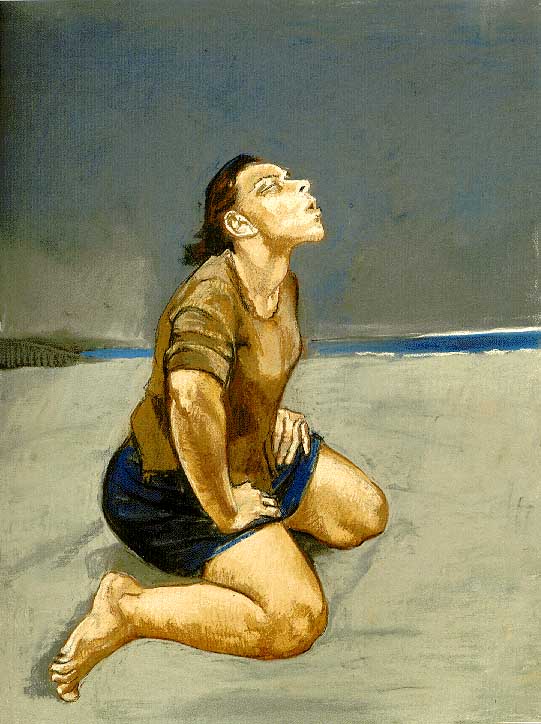
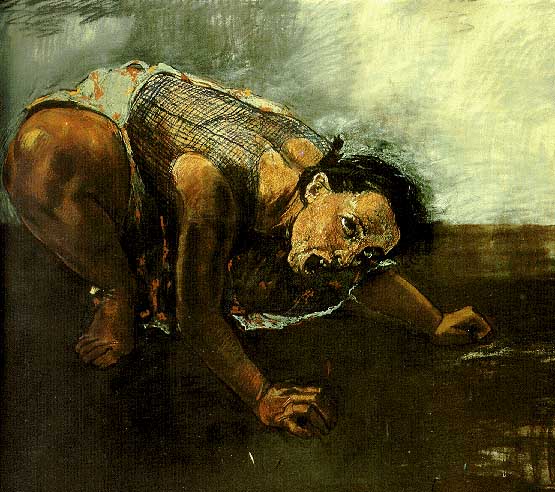
Paula Rego


These are some of the Dog Woman paintings done by artist Paula Rego. I mentioned them and mentioned I'd post them. Learn about Rego here:

  • Paula's Playground
  • Friday, November 03, 2006

    Against Reportage


    Exercise Your InkTank
    Politic Politics Political Poetry

    We’re living in a city that is (reportedly) one of the most violent in the country. So far this year there have (reportedly) been 68 murders; 273 rapes; 1,761 robberies; 879 aggravated assaults; 4, 475 burglaries; and 2, 248 auto thefts. We’re living in a state that is (reportedly) one of the most important in the upcoming elections. Over $170 million has (reportedly) been spent on campaign ads, the large majority of them negative. We’re a people who are (reportedly) fed up with politics. When we cast our votes, many of them will (reportedly) fail to be counted.

    Reportage has its place in the world. As does political propaganda. But what place does poetry have in our politics? How do we contribute to the conversation without becoming lost in the white noise of political punditry? I asked Melissa Tuckey, a friend deeply involved in both political and writing communities in D.C., to help us to approach these kinds of questions and she very graciously agreed. Here’s what she said:

    One problem with political poetry is when the writers are not open to the complexity of the problem they are writing about—or the complexity of language. It's easy with politics to reduce everything to sound bites and partisan thinking, but this is not poetry.

    The poet should be open to discovering something new about whatever subject they are writing about. Sometimes it helps to come at it from a completely illogical point of view, or angle, to see something new again.

    I also think its important not to fall into false dichotomies, “us versus them, self versus other” thinking. To recognize your own complicity in whatever evil you most abhor. To write from your conscience—to wrestle with it. CK Williams does this well.

    Ultimately I think all poetry is political in that it causes the reader to recognize and appreciate the complexity of the world. It frees us from the world of slogans and invites us to think for ourselves. That’s political.

    Many of the political poems I write end up in the trash, but it makes me feel better to write them.

    I think poets should write about things that matter.

    It’s helpful to look at poetry by poets who write successfully about such matters: some of my favorites are Whitman, CK Williams, Adrienne Rich.


    Against Reportage:
    For all that is said about us, we’re a very informed and aware people. And our knowing extends well beyond what the reports about us say. Whatever your politics, you’re a person with a voice. Like Melissa says, It's easy with politics to reduce everything to sound bites and partisan thinking, but this is not poetry. Let’s do the hard thing. Together, we’ll compile the reports about us. Individually, we’ll struggle to remain open to the complexity of the problem we are writing about—or the complexity of language. We’ll make an effort to see something new about the subject, or see it from a different angle. Even if it ends up in the trash, it might make us feel better to write it.

    Tuesday, October 31, 2006

    INFORMATION


    Exercise Your InkTank
    INFORMATION Glut

    The trouble with INFORMATION is that its transmission often raises issues of credibility, believability, and trust. INFORMATION is heavy, angular, and conspicuous. It can be very difficult to manage as INFORMATION. Here’s what can happen when INFORMATION does not rise out the story organically:

    “What’s going on here Susan? It seems like there are millions of Americans here on the shores of Lake Michigan,” said Mike. He folded his blue hat in his hands.
    “It’s the World’s Fair, silly, an incredibly popular and immensely influential social and cultural event,” said Susan. She straightened her old-looking dress at the waist.
    “We’re lucky to be here,” he said. He touched her arm—a little forward for the times.
    “We sure are. The year of 1893 is turning out to be a good one.”

    Here are some concerns I’ve often heard from group members, students, teachers, mentors, and colleagues alike:

    I want to deliver the kind of INFORMATION that convinces my readers of my credibility as a writer and/or convinces my readers of my character’s credibility without seeming like that’s what I’m doing; there’s nothing less convincing than a writer who’s obviously trying to convince you.

    I want to get technical INFORMATION into my story without turning away readers who may not be familiar with the terminology or seeming opaque.

    I want to get INFORMATION about technology, geography, politics, history, into my story that my readers will need to understand in order to follow my story, but I don’t want that INFORMATION to bog down my storytelling.

    I want to get INFORMATION into my story in order to entertain and hold the interest of my readers.

    I want to get INFORMATION into my story seamlessly—I don’t want it to seem like INFORMATION.

    Behind these concerns are very particular larger issues—issues we should talk about as writers. Right now. But the problem with INFORMATION is that it isn’t STORYTELLING. It’s INFORMATION. Working INFORMATION into a story is always going to be a challenge for that reason.

    Here goes:
    I’m going to distribute little piles of INFORMATION around the room. Choose any pile you like and investigate it. Next, write a segment (of a poem, a story, an essay, a scene or something in-between) that engages some of the ideas present in your pile. If your experiment is successful, your readers should not be able to sense the presence of the INFORMATION in your segment—they’ll be engaged in your storytelling, engaged in the continuous dream that is the world of your story. Even if INFORMATION isn’t a problem for you, this exercise will give you a chance to come into your writing at a different angle.

    Wednesday, October 25, 2006

    Political Poems Now


    FORSYTHIA WINTER
    by Melissa Tuckey

    First snap and daffodils nod off
    they always look
    so surprised

    while here in D.C.
    everything wants to bloom
    at once a profusion
    of highway exits
    and war

    I want off this crazy
    interchange forward and back
    illegal turns and still
    the land refuses

    Go ahead open your hand
    what emptiness
    will you offer

    that wild impulse the rain


    THE GENESIS OF TORTURE
    by E. Ethelbert Miller

    In the beginning
    we will all wear black hoods

    Our faces will be hidden from history and
    someone will tie a cruel footnote to our genitals

    It might be a neighbor disguised as God


    TAR
    by C. K. Williams

    The first morning of Three Mile Island: those first disquieting, uncertain, mystifying hours.
    All morning a crew of workmen have been tearing the old decrepit roof off our building,
    and all morning, trying to distract myself, I've been wandering out to watch them
    as they hack away the leaden layers of asbestos paper and disassemble the disintegrating drains.
    After half a night of listening to the news, wondering how to know a hundred miles downwind
    if and when to make a run for it and where, then a coming bolt awake at seven
    when the roofers we've been waiting for since winter sent their ladders shrieking up our wall,
    we still know less than nothing: the utility company continues making little of the accident,
    the slick federal spokesmen still have their evasions in some semblance of order.
    Surely we suspect now we're being lied to, but in the meantime, there are the roofers,
    setting winch-frames, sledging rounds of tar apart, and there I am, on the curb across, gawking.
    I never realized what brutal work it is, how matter-of-factly and harrowingly dangerous.
    The ladders flex and quiver, things skid from the edge, the materials are bulky and recalcitrant.
    When the rusty, antique nails are levered out, their heads pull off; the underroofing crumbles.
    Even the battered little furnace, roaring along as patient as a donkey, chokes and clogs,
    a dense, malignant smoke shoots up, and someone has to fiddle with a cock, then hammer it,
    before the gush and stench will deintensify, the dark, Dantean broth wearily subside.
    In its crucible, the stuff looks bland, like licorice, spill it, though, on your boots or coveralls,
    it sears, and everything is permeated with it, the furnace gunked with burst and half-burst bubbles,
    the men themselves so completely slashed and mucked they seem almost from another realm, like trolls.
    When they take their break, they leave their brooms standing at attention in the asphalt pails,
    work gloves clinging like Br'er Rabbit to the bitten shafts, and they slouch along the precipitous lip,
    the enormous sky behind them, the heavy noontime air alive with shimmers and mirages.
    Sometime in the afternoon I had to go inside: the advent of our vigil was upon us.
    However much we didn't want to, however little we would do about it, we'd understood:
    we were going to perish of all this, if not now, then soon, if not soon, then someday.
    Someday, some final generation, hysterically aswarm beneath an atmosphere as unrelenting as rock,
    would rue us all, anathematize our earthly comforts, curse our surfeits and submissions.
    I think I know, though I might rather not, why my roofers stay so clear to me and why the rest,
    the terror of that time, the reflexive disbelief and distancing, all we should hold on to, dims so.
    I remember the president in his absurd protective booties, looking absolutely unafraid, the fool.
    I remember a woman on the front page glaring across the misty Susquehanna at those looming stacks.
    But, more vividly, the men, silvered with glitter from the shingles, clinging like starlings beneath the eaves.
    Even the leftover carats of tar in the gutter, so black they seemed to suck the light out of the air.
    By nightfall kids had come across them: every sidewalk on the block was scribbled with obscenities and hearts.

    Monday, October 16, 2006

    It's Politic


    "The Colonel" by Carolyn Forche

    What you have heard is true. I was in his house.
    His wife carried a tray of coffee and sugar. His
    daughter filed her nails, his son went out for the
    night. There were daily papers, pet dogs, a pistol
    on the cushion beside him. The moon swung bare on
    its black cord over the house. On the television
    was a cop show. It was in English. Broken bottles
    were embedded in the walls around the house to
    scoop the kneecaps from a man's legs or cut his
    hands to lace. On the windows there were gratings
    like those in liquor stores. We had dinner, rack of
    lamb, good wine, a gold bell was on the table for
    calling the maid. The maid brought green mangoes,
    salt, a type of bread. I was asked how I enjoyed
    the country. There was a brief commercial in
    Spanish. His wife took everything away. There was
    some talk of how difficult it had become to govern.
    The parrot said hello on the terrace. The colonel
    told it to shut up, and pushed himself from the
    table. My friend said to me with his eyes: say
    nothing. The colonel returned with a sack used to
    bring groceries home. He spilled many human ears on
    the table. They were like dried peach halves. There
    is no other way to say this. He took one of them in
    his hands, shook it in our faces, dropped it into a
    water glass. It came alive there. I am tired of
    fooling around he said. As for the rights of anyone,
    tell your people they can go f--- themselves. He
    swept the ears to the floor with his arm and held
    the last of his wine in the air. Something for your
    poetry, no? he said. Some of the ears on the floor
    caught this scrap of his voice. Some of the ears on
    the floor were pressed to the ground.

    False Start Re-Starts by Salon Members


    The Writing Group Speaks
    by Dick Mashburn

    What follows is original but not spontaneous or unprovoked. It’s a
    response to one of the interventions of our moderator/chief instigator.
    The idea for this game is that she gave us a bunch of scraps of writing
    she found on or in the vicinity of her desk. There’s no telling if it
    was part of a significant work or just words that somehow came to rest
    on that shred of paper.

    What’s not in doubt, however, is that being dutiful writing groupers,
    we vied for the privilege of putting these would-be gems into a
    context, that like a jewelers finest setting can unlock the complete
    and true beauty that now lies passively as in a humble …

    The President, for Christ sake, is up there in a helicopter, surveying.
    “Our worst fears,” he says, “are heading South.”

    “It was those bastard Democrats,” he continued (alteration from
    original). “They roiled around making such a stink that that jerk
    SeƱior Fox got the Mexican legislature to create a whole package of
    benefits for Mexican workers. Now, instead of flooding into this
    country to take jobs nobody else wants, and behave like angels because
    they know that if they FU, we’ll send ‘em home in a heartbeat, they
    shoot down the tubes back to good old Mexico.

    “Of course somebody’s got to pay for this, and that bastard Fox got the
    legislators to put huge taxes, it’s like Nucular War on all American
    companies. By the time Ford adjusts for the new taxes, they have to
    jack the price of a “nicely equipped” Focus to $32,000. That puts their
    workers in this country out of work and they go scurrying off to North
    Carolina to work in the textile mills. Raleigh-Durham is beginning to
    look a third world country, and those S.O.B.s over there in Tsunami
    Land don’t even appreciate us sending them shirts. Said they need
    machines to make shirts, like they used to, not shirts, or worse yet,
    us exporting shirts all over the world.

    “Thanks a lot World. Thanks for the gratitude.”


    Cicadas On Us
    by Kalman Kivkovich

    2004 was the most recent emerging time of Cincinnati-17-year cicadas. I was here, waiting in anticipation. I remember my father talking to me about those fascinating insects, more than fifty years ago. I recall him claiming to have captured fifty cicadas in some glass jars, just to free them later unharmed. "I can't kill anything," he had said.
    Since my early childhood, those goldish-looking bugs had visited at least three times. But in 2004, they came in-force, never seen before. My heavenly-kingdom grounds were not spared. They came a little late, but they came-trillions and trillions of them. And their symphonic non-stop opus, MAN! They say it is exclusively-male stuff. They must know their stuff! The intense, high-pitched humming can harm your eardrums; it can be as loud as a 747 Delta Jet flying over Clifton; it surely fends off birds, sometimes.
    I was brave, my wife wouldn't dare to come within a foot and even then I had to hold her hand. I collected a few specimens, housing them in an empty glass pickle jar. Yes, I did pierce the tin cover for breathing air---like my dad, I didn't want to kill them. I waited for them to sing, but they were not in the mood, I guess. All they did was crawl on top of each other. After a few days, there were fewer that still crawled . . . and then came the stench . . . and then came the second empty glass jar---this time it was from mayonnaise, just in case the new cicadas liked it better.
    I observed my prisoners closely; my nose was touching the glass. I didn't bother to feed them; they say that cicadas don't eat anything, and that they have already stuffed themselves of tree sap underground. So I just looked at them carefully, I looked at their huge red eyes, one on each side of the head and at the other three little shiny eyes on top of their head. With their wings, they resembled common giant houseflies. The wings were fascinating---glassy and transparent wax-paper-like held by an elaborate vein structure---reflecting sunlight in shimmering rays. My eye traveled to their legs, And legs they have---three pairs of them.
    After a two-day clinic, I decided to let my jailbirds go free. Only two were still moving, the rest were stock-still; a few sparkly wings littered the bottom of the jar. I had read that cicadas don't bite; they didn't harm me thus far, although they were everywhere: covering my trees, shrubs, grass, walls and even the windshield of my car. In most cases they simply took off and flew when approached.
    I stepped out to the porch. "Okay, little fellows," I said, "your days are numbered anyway. Go find yourself a mate, have fun and die." I took the lid off and shook the jar. No takers. I tapped on the glass. "Go, go you . . ."
    And off they went. I wouldn't know if it was a hop or a natural take off. The two creatures flew straight into my thick curly hair. I was startled; I jumped backward, my hands reached up, searching to grab the unforeseen attackers. "Sons of bitches!" I yelled, "Get off me, you bastards!" I ran back into the house and jigged my way to the dinning room.
    Locks of hair dropped to the floor. The cicadas kept clinging to my scalp, burying their claws in my now rapidly disappearing hair. The place looked a lot like a barbershop, not a dining room. My screaming and jumping were in vain. By the time I managed to rid myself of those Devils, I was petrified to glance at a mirror; the floor spoke volumes. The two cicadas were still alive, still clenching to some strands of my past glory. In my anger I raised my foot to crush them . . . and then again I remembered my father. "Damn it, I can't!" I scooped the mess into a paper beg and emptied its contents in the woods behind my deck. When I returned, I barely gathered the nerve to peek at my image in the bathroom mirror. "My God, what will Sandi say?" I said to myself. I looked so much different. Heartbroken, I left the bathroom. I took off my sandals and headed to the bedroom. My right foot hit the doorjamb. "Fuck! Oh God . . ." In an instant, all my grief of loosing my hair had vanished---I was dancing, kicking my legs up and high. . . .

    It has been a couple of years since my encounter with those terrestrial flying vermin. I still have some hair left, but not much to brag about. The important thing is that my wife likes it as it is, so she says. And one more thing: I have been told by many that my Jive has improved. . . .


    CICADAS AND OTHER FANTASIES KEPT IN GLASS JARS
    by Sandi Kivkovich

    My father claims to have captured fifty cicadas in glass jars.
    He also claims to have freed them.
    "I can't kill anything," he said.
    My father claims he can tell when it is going to rain.
    His sisters tell how as a child he pretended to be the wind and the storm cloud.
    "I can't hide my feelings," he said.
    My father claims he can tell a story about anything.
    He captivated my youth and beyond.
    "Life is a story," he said.
    My father claims that he understands feelings.
    All are important.
    "A child's problems seem as large to them as those of adults," he said.
    My father claims he is fine.
    He slaps his knee and laughs and sings songs in gibberish to me.
    "What's your name little girl?" he said.

    New Wheels


    Exercise Your InkTank

    The story goes that false starts can be useful failures—at least you’re writing, right?—but as useful as they are, they can also be demoralizing, frustrating, intimidating, exasperating, and annoying. Over time you may develop a sense for what has wheels and what doesn’t, but even the most experienced of writers have false starts. I know several novelists who have written several (one of them five) novels, before they’ve found the story they wanted to tell. They regard their novels-never-to-be in this way: it’s precious trash. Some writers cannibalize old failed projects, pulling a few lines, an image, or even a chapter into their current work. Some simply take what they’ve learned and translate it. But what do you do with those pages-that-go-nowhere sitting on your hard drive after you’ve scrapped them for the metal?

    Here’s one idea: you give them away. My gift to you this evening is a collection of little fits and starts, all of Salon-workable length, all culled from my fail-files. See what you can do with them. Pick any one or two you like and revise it in any way you please. It’s yours now. I won’t need it back when you’re done.

    1. Again it happens that I am terrible. It isn’t often that every face looks petulant. Even the ones I don’t know. And the meaning the world has to offer is ground down, a smart kick, or there’s merely the birds in their sheer numbers winding the cycle of the rooftops and me. You can look and there they are. And then that’s all there is.

    2. I rent a cottage on a two-mile spread with another rental set up ten feet across a gravel drive from mine. The other place is a three bedroom house. Probably a hundred years old. I live in its converted shed. Probably once the site of an outhouse. It’s nice though, remodeled. The stove almost works, carpet’s stained, but you can work around these things, or over. The neighbors are boys, maybe eighteen, maybe still in high school. I did not know that this would happen when I moved in.

    3. My father claims to have captured fifty cicadas in glass jars.
    He claims also to have freed them. “I can’t kill anything,” he said.

    4. I never wanted a good explanation for heat lightening.

    5. I was little when my mother first told me not to get my hopes up. She said it would hurt more in the end if you went in thinking positive. And, if you went in expecting failure, think how good you’d feel about it if you had luck. I was an awkward girl and it struck me she was probably right. I went into womanhood expecting it would turn out poorly. My hopes were so low, good weather excited me. When I hit high school, I couldn’t get a date. Then it came out I was easy because who’d date a girl with a sack of bricks for an ass? I played that game and I wasn’t stupid about it. I knew about taking what you can get and what it can get you. I kept my eye off the prize. Once I’d had it done to me every way by most everybody, I figured life would get measly and lonely again. I figured at best I’d marry somebody cheaper than me and bury his complaints in my thighs. But then Walter showed up with his hands stroking my back like I was a little bird. Walter showed up and it was love, love, love.

    6. The last thing the widow says to her keeper is, do not try to know how to say love. Many times we fail disbelieving. Is it you? Is it you? Are you the one? I don’t want you to tell me. It’s something we’ve already done. And so we must sleep. We must decide now that our living here is enough.

    7. There is only as much tension in the finest disguises.
    Otherwise, we would always be thieves.

    8. All kids believe in God and sugar.

    9. The President, for Christ sake,
    is up there in a helicopter, surveying.
    Our worst fears, he says,
    are heading South.

    Wednesday, October 11, 2006

    As Promised: Three Prose Poems by Russell Edson


    Grass

    The living room is overgrown with grass. It has
    come up around the furniture. It stretches through
    the dining room, past the swinging door into the
    kitchen. It extends for miles and miles into the
    walls . . .

    There's treasure in grass, things dropped or put
    there; a stick of rust that was once a penknife, a
    grave marker. . . All hidden in the grass at the
    scalp of the window . . .

    In a cellar under the grass an old man sits in a
    rocking chair, rocking to and fro. In his arms he
    holds an infant, the infant body of himself. And
    he rocks to and fro under the grass in the
    dark . . .


    Accidents

    The barber has accidentally taken off an ear. It lies like
    something newborn on the floor in a nest of hair.
    Oops, says the barber, but it musn't've been a very good
    ear, it came off with very little complaint.
    It wasn't, says the customer, it was always overly waxed.
    I tried putting a wick in it to burn out the wax, thus to find my
    way to music. But lighting it I put my whole head on fire. It
    even spread to my groin and underarms and to a nearby
    forest. I felt like a saint. Someone thought I was a genius.
    That's comforting, says the barber, still, I can't send you
    home with only one ear. I'll have to remove the other one. But
    don't worry, it'll be an accident.
    Symmetry demands it. But make sure it's an accident, I
    don't want you cutting me up on purpose.
    Maybe I'll just slit your throat.


    Antimatter

    On the other side of a mirror there's an inverse world,
    where the insane go sane; where bones climb out of the
    earth and recede to the first slime of love.

    And in the evening the sun is just rising.

    Lovers cry because they are a day younger, and soon
    childhood robs them of their pleasure.

    In such a world there is much sadness which, of course,
    is joy.
    But it has to be an accident . . .

    Friday, September 29, 2006

    Found Poems by Salon Members


    Please note: selections have been published in order of their submission. If you'd like to publish your found poem on the blog, please submit it via the Writers Salon yahoo group.


    AN ANCIENT IMMOVABLE ARM

    An ancient immovable arm,
    Invisible, balanced.
    An ancient immovable arm,
    With prolong sound, merged people with pain, grief,
    Energy, fierce pride and pleasure.

    The words were borrowed from Webster, page 797 (Ms).

    Kalman Kivkovich

    A CONSTELLATION OF GROWTH

    A constellation of days designated
    for planting trees,
    for flowing water, not restrained or limited,
    style flavored with caraway seeds,
    people growing, trembling or quivering with excitement.

    Words taken from Webster's Dictionary Page 63 (A's)

    Sandi Kivkovich


    POPEYE'S "SMOKING GUN"

    This new food fear
    becomes inconvenient again.
    71 percent were women,
    after discovering
    an opened bag of spinach.
    Nine California farms
    zero in on three
    health authorities.
    The "smoking gun"
    has died.
    Watch how the leafy green,
    the tainted greens,
    could be a crucial clue.

    from the CNN article "Health chiefs find 'smoking gun' spinach" dated 9/21/06
    Jason Gallagher

    Find Found Poetry


    Exercise Your InkTank
    Writing without Composing

    If you’ve never heard of found poetry, you’re about to because:
    1. It’s everywhere
    2. Everybody’s doing it, whether they intent to or not (see Donald Rumsfeld)
    3. It’s a good way to see language as language
    4. Its critique of the way we use language is implicit (built-in)
    5. Its critique of the culture in which the original text was created is implicit
    6. You’ve decided to attend the Salon and there’s no escaping it now

    The rules are very simple: using ordinary texts from the world around you, create a poem. Do not write. Compose. You may subtract lines of text and re-arrange them, but you may not add any words or phrases of your own. Your poem need not follow any formal structure (although it can, if you like) but pay close attention to what line breaks can do to the meaning and rhythm of your lines. A line as simple as the one I am writing now, can begin to look like a poem quite easily:

    A line as simple
    As the one I am
    Writing now can
    Begin to look like a poem
    Quite easily.

    Below you’ll find a few examples of famous (notorious) found poems. A simple Google search will provide you with a few thousand or million more. We’ll draw our original texts from a hat. Should no hats prove present or available to us, original texts will be drawn in some other equally exciting and totally random fashion. Feel free to write on your original text (maybe crossing out or highlighting words or phrases) and then transfer your found poem to the back of this sheet. Try to compose (not write) at least five lines. We’ll share them and then the best (to be determined by wild hooting and hollering) will be published on the blog.

    THE UNKNOWN
    As we know,
    There are known knowns.
    There are things we know we know.
    We also know
    There are known unknowns.
    That is to say
    We know there are some things
    We do not know.
    But there are also unknown unknowns,
    The ones we don't know
    We don't know.

    Donald Rumsfeld, Feb. 12, 2002,
    Department of Defense news briefing


    A CHALLENGE TO YOUR SPIRIT
    Girls and boys of America
Are the hope of the world!
You can’t evade it, young America.
    And are you going to go on dancing
And spinning on your ear?
What are you thinking about, sitting
    There staring into the dark?
Haven’t you been lying around long
    Enough?
    Shouldn’t you go to work?
    Find as interesting a subject as possible.
Write as vivid a sketch as you can
Of a person who attracts you or an animal.

    Annie Dillard from “Junior High English” from Mornings Like This: Found Poems

    Sunday, September 17, 2006

    Take-Out Sestina


    The Take-Out Assignment for the week is to write a sestina with these six (Salon-generated) end-words: metrosexual, obtuse, crystal, equivocate, time bomb, terrorist. Take a look at the craftshop post for the formal structure the sestina follows. Consider shifting the words for variety and telling a story with a cohesive narrative. We'll take a look at these on Thursday -- we've already seen a few remarkable entries.

    Orange saccharine Narcotics Orgasm Frosty Cascade


    A Partial Sestina by the Salon Collective on the Spot

    Her eyes caught my gaze like fresh narcotics
    An unattented hookah burned shisha so saccharine
    Silvery water that roared nature's orgasm
    Evaporating condensing perspiration turned frosty
    Removing all memory of a world with colors rippling red ostentatious orange.

    Better than narcotics are oranges
    What the hell am I doing with these narcotics
    They only make the rings in my nost frosty
    It lingers on the lips of my love like an orgasm
    Goose bumps down my back cascade

    Down Main Street we cascade
    To a room painted bright orange
    Many colors in your mind like a mental orgasm
    Stawberry fields forever these are great narcotics
    Ripped out mouth smiles saccharine
    Frosty

    Formal Attire


    Exercise Your InkTank

    Today we’re going to try on some formal constraints. That’s right. We’re getting conventional up in here. Maybe you’ve written some formal poetry before, a few pantoums or a villanelle, perhaps. Maybe you’ve written poems before but nothing formal because formal poetry is stale and frusty and/or absolutely terrifying. Or maybe you’ve never written a poem before at all. No matter your disposition or level of experience, the truth (and it’s not one I’m making up this time) is that formal constraints are a good way to free yourself from habit and to invite real invention into your writing space. You may find a new turn of phrase or a new image, a new story or a new voice, or you may simply find that a new form reminds you of what you valued in more familiar forms. At a minimun, you’ll leave today having written a sestina with your fellow Salonists.

    The Suit
    A sestina. Let’s talk about what that is first: It’s a poem consisting of six six-line stanzas and one three-line envoy. The end-words (we’ll generate these together) in each stanza are the same, but they follow different sequences. Here’s the pattern the sestina follows:

    1 2 3 4 5 6 - End words of lines in first sestet.
    6 1 5 2 4 3 - End words of lines in second sestet.
    3 6 4 1 2 5 - End words of lines in third sestet.
    5 3 2 6 1 4 - End words of lines in fourth sestet.
    4 5 1 3 6 2 - End words of lines in fifth sestet.
    2 4 6 5 3 1 - End words of lines in sixth sestet.
    (6 2) (1 4) (5 3) - Middle and end words of lines in tercet.

    The Tailors
    Who comes up with this stuff? In this case, the French. The sestina appeared in France in the twelfth century, initially in the work of a troubadour. Why are we here at InkTank writing a sestina? Because the sestina is one of the best poetic forms for storytelling. Its repetition and long line-length make it an ideal form for our purposes. What are our purposes? We’re all about storytelling here, no matter the genre. Why do we keep using forms the French developed? It is merely a coincidence, I assure you.